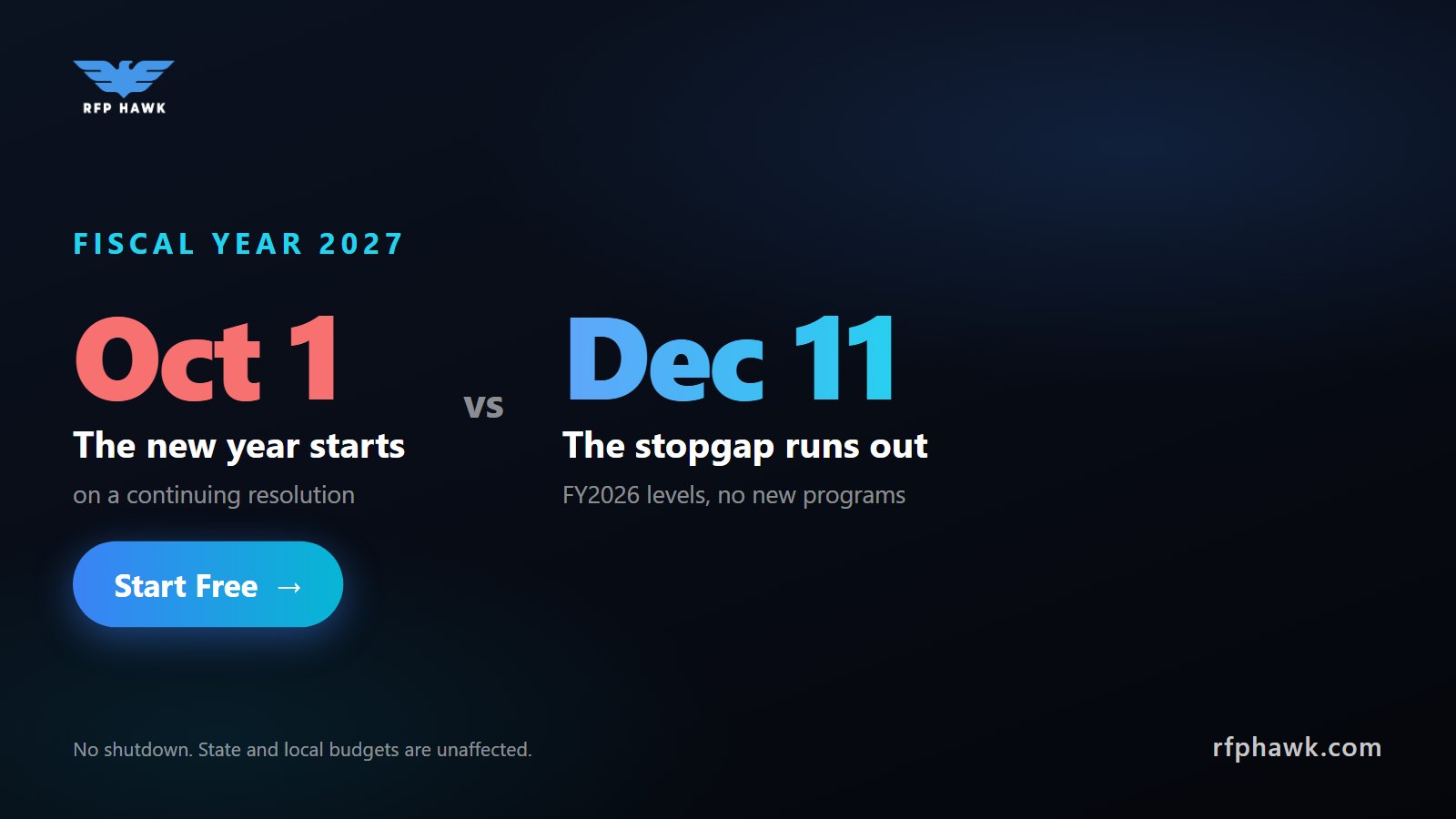
Fiscal year 2027 starts on Wednesday, October 1, and it starts on a continuing resolution. Congress passed a stopgap in early September that funds the government through December 11, 2026, at fiscal 2026 levels. So there is no shutdown, but there is also no full-year budget. For contractors, that means existing work keeps moving, new programs wait, and some federal awards slow down while agencies wait for real numbers. State and local governments are not affected at all. Here is what the CR actually does, what it doesn’t, and how a small firm should use the next ten weeks.
What is a continuing resolution?
A continuing resolution is a temporary spending law. Congress is supposed to pass twelve appropriations bills before the federal fiscal year starts on October 1. When it doesn’t, it passes a CR instead, which keeps agencies funded at roughly the prior year’s level for a set number of weeks.
That is the normal state of affairs, not a crisis. According to Pew Research, Congress has passed all of its required spending bills on time only four times in nearly five decades: fiscal 1977, 1989, 1995 and 1997. Nearly every year begins the way this one does.
What does this year’s CR do?
The fiscal 2027 stopgap is short and conventional:
| Item | What it says |
|---|---|
| Funding runs through | December 11, 2026 |
| Funding level | Fiscal 2026 levels |
| New programs | Not allowed |
| New multiyear contracts | Not allowed |
| House vote | 370 to 48 |
| Senate vote | 90 to 6 |
Per Breaking Defense, the bill includes the standard language that “prohibits using funding to start new programs or multiyear contracts,” and it turned down several Pentagon requests for exceptions. The CRA’s summary notes it pushes the final funding fight past the November midterms.
What keeps moving under a CR?
Most of the government’s routine buying. A CR funds agencies to keep doing what they did last year, so work that continues an existing program generally proceeds:
- Existing contracts and orders. Work already under contract keeps going, and agencies can keep placing orders against existing vehicles for ongoing needs.
- Recurring services. Janitorial, maintenance, IT support, and similar services that run year after year are the core of “continuing” operations.
- Small purchases. Micro-purchases, now up to $15,000, and simplified acquisitions for routine needs keep happening.
- Federal notices. Solicitations, sources-sought notices, and awards keep posting to SAM.gov. Our feed tracked 17,048 federal records this morning.
The practical rule: if the work looks like last year’s work, a CR usually doesn’t stop it.
What slows down or waits?
Anything new, bigger, or longer than last year:
- New programs (often called new starts) cannot begin under this CR.
- New multiyear contracts are barred.
- Increases over last year’s level, such as higher production rates, generally wait for full-year funding.
- Cautious timing. Even where awards are allowed, agencies often hold larger or discretionary buys until they know their final budget. That can push some awards from October into December or later.
How much slows down varies a lot by agency and program. If you are waiting on a specific award, option, or order, the only reliable answer comes from the contracting officer on that action.
Why state and local work doesn’t care
A federal CR has no effect on state, county, and city budgets. According to NCSL, 46 states start their fiscal year on July 1, so their budgets for the year were settled three months ago. The exceptions are New York (April 1), Texas (September 1), and Alabama and Michigan (October 1).
That matters because state and local work is about half the market. Of the 33,321 opportunities our feed tracked this morning, 16,273 came from state and local sources, and 2,216 new opportunities posted today across federal and state. If federal awards go quiet in October, the state and local side keeps buying on its normal schedule.
How should a small contractor use the next ten weeks?
Treat October through mid-December as a planning window, not a pause:
- Shift some attention to state and local bids. They are unaffected, and registering on the right state portals is free.
- Answer sources-sought notices. Agencies keep planning under a CR. Sources-sought responses shape next year’s set-asides, and they cost little to write.
- Keep your SAM.gov registration active. Registration renews annually, and an expired one blocks awards the moment funding arrives.
- Build your pipeline from forecasts. Use agency procurement forecasts to line up the work that will move once full-year funding lands.
- Watch December 11. That date brings full-year bills, another CR, or a shutdown risk. Know which of your opportunities depend on the answer.
What this guide can’t tell you
- Whether Congress will finish by December 11. Another CR is common; a lapse is possible. Nobody knows yet.
- What your agency will do. Spending plans under a CR vary by agency and program, and most are not public.
- Whether a specific contract, option, or order is funded. Ask the contracting officer. This article is general information, not legal or financial advice.
Key takeaways
- FY2027 starts October 1 on a continuing resolution through December 11, 2026, at fiscal 2026 levels. There is no shutdown.
- Routine and recurring federal work generally continues. New programs and new multiyear contracts wait.
- State and local contracting is unaffected. 46 states started their fiscal year on July 1.
- Use the window to pursue state and local bids, answer sources-sought notices, and keep SAM.gov active.
Frequently asked questions
What is a continuing resolution?
A continuing resolution, or CR, is a temporary spending law Congress passes when the regular appropriations bills are not finished by October 1. It keeps agencies funded, usually at the prior year’s levels, for a set period. It prevents a shutdown but does not give agencies a full-year budget.
Is there a government shutdown on October 1, 2026?
No. Congress passed a continuing resolution in early September that funds the government through December 11, 2026, at fiscal 2026 levels. The House vote was 370 to 48 and the Senate vote was 90 to 6. The next deadline is December 11.
Can agencies award new contracts during a continuing resolution?
Generally yes, for work that continues existing programs at last year’s funding level. What a CR typically blocks is new programs, new multiyear contracts, and production rate increases. Agencies also tend to move cautiously until full-year funding arrives, so some awards slow down.
Does a federal continuing resolution affect state and local contracts?
No. State and local governments run on their own budgets. Forty-six states start their fiscal year on July 1, so their budgets for this year are already in place. State and local bids keep posting whatever happens in Washington.
How often does Congress pass the budget on time?
Rarely. According to Pew Research, Congress has passed all of its required spending bills on time only four times in nearly five decades: fiscal 1977, 1989, 1995 and 1997. Continuing resolutions are the normal way the federal year begins.
Recommended
- Federal Fiscal Year-End: How to Win the September Rush: the week before this one
- How to Find Local Government RFPs: the half of the market a CR never touches
- Sources Sought Notices: how to shape next year’s set-asides now
Put RFPHawk to work on your pipeline.
Federal SAM.gov plus a growing list of state portals, refreshed daily and scored against your profile so you see the bids worth pursuing first.
Start free — no credit card