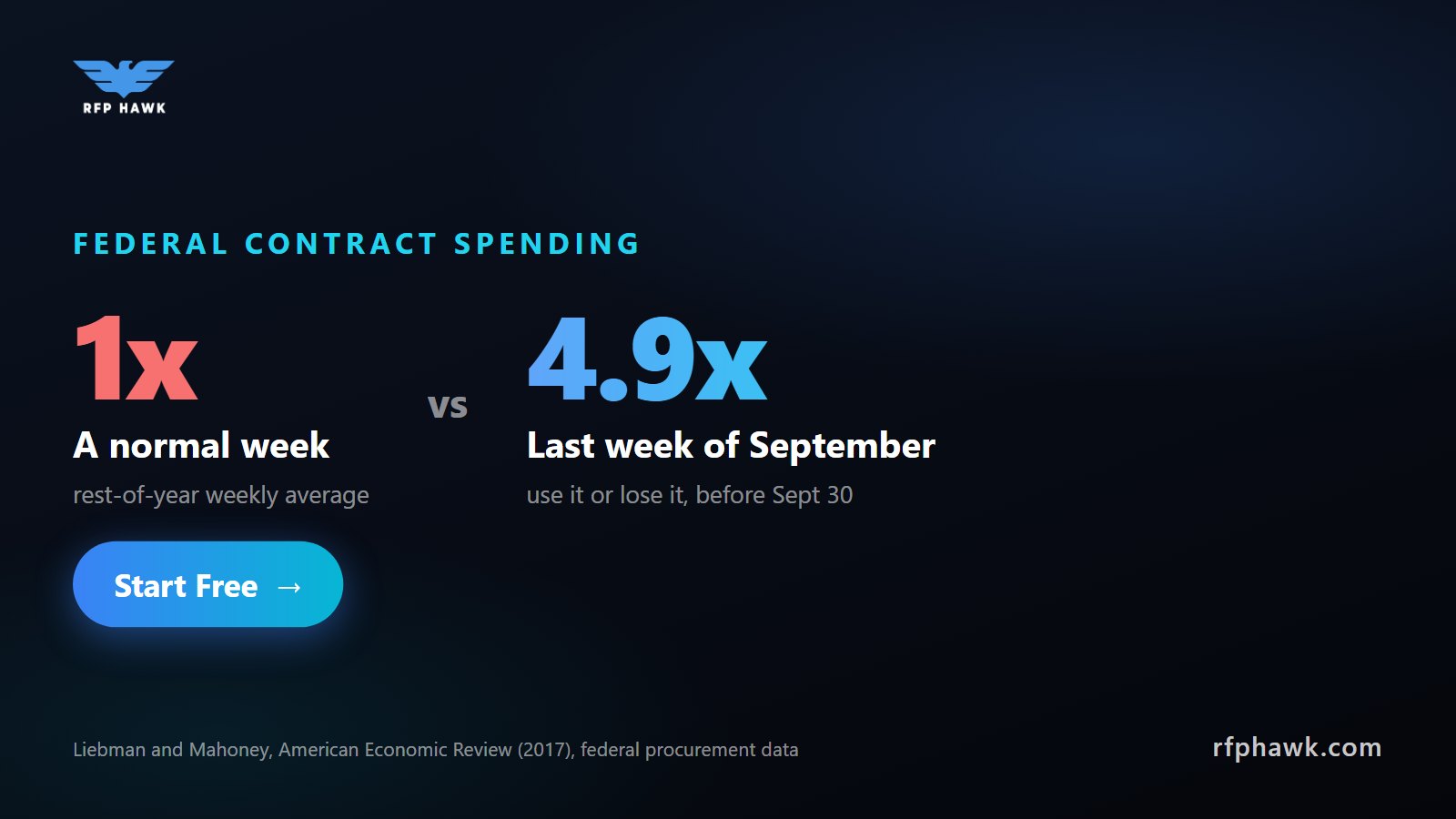
The federal fiscal year ends on September 30, and the last week before it is the busiest spending week of the year. Agencies have annual money that expires if it is not committed to a contract by that date, so they buy fast. How fast? One study of federal procurement found spending in the final week runs 4.9 times the average week for the rest of the year. For a small business, that rush is real opportunity, but only for firms that are already registered and easy to buy from. This guide explains why the spike happens, what you can realistically still do before September 30, and how to set up for a slow October.
Why does federal spending spike in September?
Because most of it is use it or lose it. The federal fiscal year runs from October 1 to September 30, and most agency operating money comes in one-year appropriations. Funds that are not obligated, meaning committed to a contract or order, by September 30 expire for new obligations. No program manager wants to hand money back and then argue for the same budget next year, so September becomes the month everything that was “almost ready” gets bought.
The size of the effect is not folklore. Economists Jeffrey Liebman and Neale Mahoney studied contract-level federal procurement data and found that spending in the last week of the year is 4.9 times higher than the rest-of-the-year weekly average. Their work was later published in the American Economic Review.
The same paper has a sting in the tail: year-end information technology projects had substantially lower quality ratings. Rushed buying produces rushed results, which is worth remembering when you are the vendor being rushed.
What changed this year: the $15,000 micro-purchase
If you last read a government contracting guide more than a year ago, one number is out of date. A FAR inflation adjustment that took effect on October 1, 2025 raised two key thresholds in FAR 2.101:
| Threshold | Old | Now | Why it matters |
|---|---|---|---|
| Micro-purchase | $10,000 | $15,000 | No competitive quotes required when the price is reasonable |
| Simplified acquisition | $250,000 | $350,000 | Streamlined procedures and shorter windows |
Micro-purchases are the fastest money in government. They can be awarded without soliciting competitive quotations when the price is reasonable, and the government purchase card is the preferred way to pay for them. In September, a contracting office with leftover funds and a short list of small needs is exactly where a $14,000 purchase happens in an afternoon. The 50% bump means more of those needs now fit under the line.
Can a small business still catch the rush with nine days left?
Honestly, some can and most cannot. The difference is preparation you did months ago. Here is what is still realistic in the final days:
- Be buyable today. An active SAM.gov registration, your UEI, a W-9, and a clear price list. If a buyer has to wait on your paperwork, they will pick someone who does not make them wait.
- Answer quick-turn quotes the same day. Year-end requests for quotes often have short response windows. Speed and completeness beat polish this week.
- Make micro-purchases easy. Accept credit cards, quote fixed prices for defined packages under $15,000, and put that offer in writing where a buyer can find it.
- Talk to the small business office, briefly. Most agencies have an Office of Small and Disadvantaged Business Utilization. In September, those people are swamped, so send a short note with your capability statement and one line on what you can deliver before September 30. Save the long introduction for October.
- Watch what is posting right now. Our feed shows 16,448 open opportunities this morning and 1,926 added today alone. Filter to your NAICS codes and check daily through the 30th instead of weekly.
If you are not registered in SAM.gov yet, do not try to sprint into this year’s rush. Registration takes roughly one to two weeks, which lands you on the far side of September 30. Start it today anyway, because it sets you up for everything below.
What happens on October 1?
The fiscal year flips, and the pace usually drops hard. Congress rarely finishes all of its appropriations bills by October 1, so agencies often start the year under a continuing resolution. A CR keeps the lights on at roughly last year’s levels but typically blocks new programs, which means the new projects you hoped to bid can wait for weeks or months.
That makes October a planning month, not a selling month:
- Read agency forecasts. Many large agencies publish procurement forecasts of what they expect to buy in the coming year. We cover where to find them in our guide to finding government RFPs.
- Research who won this year’s work. Year-end awards post to public data over the following weeks. Our walkthrough on who won a government contract shows how to use them to find incumbents and price points.
- Line up the next September now. The firms that win the rush are the ones agencies already know. Twelve months is enough time to get registered, win a few small jobs, and be the obvious call next year.
What the September rush won’t do for you
A few honest limits, because the rush gets oversold:
- The 4.9x is an average across federal procurement. It does not mean your agency, your category, or small-business awards specifically will grow 4.9 times.
- Most year-end dollars go to buys already in motion. Contracts that closed in September were usually planned in spring. The rush speeds up decisions; it rarely creates brand-new relationships.
- Rushed work has consequences. The same research found lower quality on year-end IT projects. Do not promise delivery you cannot hit just to catch a deadline, because your first federal past performance rating matters more than one fast sale.
- Deadlines are the agency’s, not ours. RFPHawk shows the due date each portal publishes and links to the original notice. Always confirm the deadline at the source before you submit.
Key takeaways
- The federal fiscal year ends September 30, and the last week sees spending about 4.9 times a normal week.
- The micro-purchase threshold is now $15,000 and the simplified acquisition threshold $350,000, both since October 1, 2025.
- In the final days, the wins go to firms that are already registered, quote fast, and make small purchases easy.
- October usually starts slow under a continuing resolution. Use it to plan next year’s pipeline.
Frequently asked questions
When does the federal fiscal year end?
September 30. The federal fiscal year runs from October 1 to September 30, so fiscal year 2027 begins on October 1. Annual funding that has not been obligated by September 30 generally expires for new contracts, which is why agencies rush to spend it.
Why does government spending increase at the end of the fiscal year?
Because most annual funding is use it or lose it. Money not obligated by September 30 cannot be used for new contracts afterward. Research on federal procurement found spending in the last week of the fiscal year runs 4.9 times the average week for the rest of the year.
What is the micro-purchase threshold in 2026?
$15,000. A FAR inflation adjustment raised it from $10,000 effective October 1, 2025, and raised the simplified acquisition threshold from $250,000 to $350,000. Micro-purchases can be awarded without competitive quotes when the price is reasonable, often on a government purchase card.
Can a small business still win work before the fiscal year ends?
Yes, if it is already registered and easy to buy from. The realistic wins in the final days are micro-purchases and quick-turn quotes. If you are not registered in SAM.gov yet, registration takes one to two weeks, so use this year-end to set up for next year instead.
What happens to government contracting in October?
The new fiscal year often starts slowly. When Congress has not passed full-year budgets by October 1, agencies operate under a continuing resolution, which typically blocks new programs. It is a good month to build pipeline from agency forecasts rather than expect fast awards.
Recommended
- How Long Does It Take to Win a Government Contract?: where the fast wins live
- How to Win Your First Government Contract: the step-by-step roadmap
- SAM.gov Registration Guide: get buyable before next September
Put RFPHawk to work on your pipeline.
Federal SAM.gov plus a growing list of state portals, refreshed daily and scored against your profile so you see the bids worth pursuing first.
Start free — no credit card